Sunday, January 25, 2015

Poor Economics and Food Subsidy


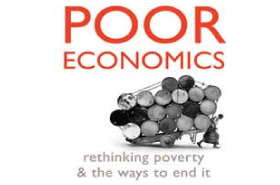
Book Excerpts from Poor Economics by Abhijit V Banerjee and Esther Duflo. While the book talks about things like healthcare, education, entrepreneurship, micro-credit, poverty etc but i did not find much about food. An omission. I have added something to this narrative which is a revolutionary approach to solving the problem of subsidy delivery.
Every year 9 million children die before their fifth birthday. A woman in sub-Saharan Africa has a one-in-thirty chance of dying while giving birth - in the developed world, the chance is one in 5,600. There are at least twenty-five countries, most of them in sub-saharan Africa, where the average person is expected to live no more than fifty-five years. In India alone, more than 50 million school-going children cannot read a very simple text.

The problem seems too big, too intractable. Students shown images of sick and dying people out of food shortages in Malawi donated more generously when a victim chosen randomly was shown. When told that the two images they were shown of had something special in them, and that people are more likely to donate to an identifiable victim, students donations more or less became the same. We feel our contribution will be a drop in the bucket, and that the bucket probably leaks.

This book is an invitation to think of the whole set of problems which when once properly identified and understood, can be solved one at a time. The western world is roughly divided into two groups, one lead by Jeffry Sachs, advisor to the United Nations, director of the Earth institute at Columbia University in New York City. He Says poor countries are poor because they are hot, infertile, malaria infested, often landlocked; this makes it hard for them to be productive without an initial large investment to help them deal with these endemic problems. But they cannot pay for the investments precisely because they are poor- they are in what economists call a “poverty Trap”.

The other side represented by William Easterly, who battles Sachs has become one of the most influential anti-aid public figures. Dambisa Moyo has joined her voice to Easterly's and both argue that aid does more bad than good: It prevents people from searching for their own solutions, while corrupting and undermining local institutions and creating a self-perpetuating lobby of aid agencies. The best bet for poor countries is to rely on one simple idea: When markets are free and the incentives are right, people can find ways to solve their problems. They do not need handouts, from foreigners or from their own governments. They say poverty is a white man's burden which he has to live with.

Whom should we believe? Rwanda received generous aid after the genocide and prospered. Now president Paul Kagame has started to wean the country off aid. Should we wait and watch for the final word to see if there is another economic downturn or consider the good that aid has done and lay pipes from the rich countries to the poor. There is data on a couple of hundred countries in the world to show that those that received more aid did not grow faster than the rest. Perhaps the opposite can be true too and that the aid helped them avoid major disaster, and things would have been much worse without it. We simply do not know; we are just speculating on a grand scale.

In the book authors try to answer if particular instances of aid did some good or not and nothing about whether aid is good or bad per se. Authors cannot say anything about efficacy of democracy but they have something to say about whether democracy could be made more effective in rural Indonesia by changing the way it is organized on the ground and so on.

What really matters is not so much were the money comes from, but where it goes. No one really disagrees that we should help the poor when we can. A philosopher observes that most people would willingly sacrifice a $1000 suit to rescue a child seen drowning in a pond and argues that there should be no difference between that drowning child and the 9 million children who, every year, die before their fifth birthday.

Philosophers agree that poverty leads to an intolerable waste of talent. Poverty is not just a lack of money; it is not having the capability to realize one's full potential as a human being. A girl from Africa may not get the nutrition to be the world-class athlete she might have been, or the funds to start a business if she has a great idea.

She could become sick and make traveling people from the developed world sick. Had she gone to school she might have turned out to be the person who invents a cure for a disease or perhaps, she would end up as a business tycoon employing thousands of others. And even if she doesn't what could justify not giving her a chance?

Implicit in the argument is that we know how to help people in distress. Yes we do, we know we need to supply education and health care in heavy doses, how to do them while turning the outcomes to your liking is the real matter. The point is simple: Talking of the problems of the world without talking about some accessible solutions is the way to paralysis rather than progress.

The book talks about malaria affecting millions in Africa and a simple solution of a bed net and the economics of its supply and demand. It asks, What is the best way to make sure that children sleep under bed nets?

Moyo tells the story of how a bed-net supplier was ruined by a free bed-net distribution program. When free distribution stopped, there was no one to supply bed nets at any price.

To shed light on this debate we need to answer three questions.
First, if people must pay full price(or at least a significant fraction of the price) for a bed net, will they prefer to go without?
Second, if bed nets are given to them free at some subsidized price, will people use them, or will they be wasted?
Third, after getting the net at subsidized price once, will they become more or less willing to pay for the next one if the subsidies are reduced in the future?

Significance of the book for India:

Products or services such as education or healthcare or micro credit are good to have but people do not seem to value them enough to demand larger public outlays. The problem is compounded by mediocre services currently being offered by the government health and education departments. Bed net protects us from diseases and its demand may fall if mosquitoes menace is tackled. Food is something which will never go out of demand.
Regarding food in the Indian context, our farmers are in distress.
The problem is manifold. Reducing farm incomes and land holding sizes due to sub-division among family members. Increasing number of landless laborers on farms, informal tenancy agreements and lack of tenancy registration. Water shortages and other environmental factors like drought and floods. Lack of soil testing and adequate use of fertilizers in appropriate ratios. Illiteracy of farmers and inability to shift to industry or services. Regulatory restrictions and monopolies in agricultural produce marketing yards. Overemphasis on rice and wheat production as a result of increasing MSPs year after year to the detriment of other crops.
If we were to help our, what would be the best way? They need help but the way we provide help matters. Food prices are a factor of demand and supply and due to vagaries of nature Indian Food Prices experience a lot of volatility. Farmers are at the mercy of the middlemen.
How can governments incentivize the markets to pay remunerative prices to the farmers unless it intervenes. A little bit about the context in which i speak needs to be told.
India has a large organization with multi-billion dollar budget to procure, store and release grains in the market. This organization called the Food Corporation of India(FCI) controls the market. Another purpose of this organization is to maintain a buffer of grains in case of shortages and export excess grains in case of bountiful harvest.
The problem is that FCI due to operational and budgetary constraints is not able to procure from all farmers across the country. It does major portion of wheat procurement from Punjab and Haryana and rice from the southern states. So some of the farmers are at the mercy of traders.
If FCI has to work effectively its losses have to be reduced. Major losses occur due to high prices at which FCI procures grains and low prices at which it sells them. Procurement prices and prices at which FCI issues(Issue price) grains to the states are both determined by the agriculture/food ministry. States manage the public distribution system through the fair price shops and the country as a whole has nearly only 450 thousand fair price shops. While market prices for food grains are higher fair price shops sell grains at lower rates. This naturally creates incentives for diversion. In poorer states there is large scale diversion and trucks laden with grains never reach the FPS. In some Fair Price Shops(FPSs), managers cheat too.
Technocrats have looked at the problem and suggested several measures. One of them being direct benefit transfer. Direct benefit transfer involves selling grains to customers at market rates and then getting a rebate into the bank accounts equal to the difference in the subsidized price and market rates. They argue that once grains move at market rates from the FCI to the consumer there is lesser incentive for diversion.
There are several opponents of the cash transfer idea. They argue that bank branches are scarce in the villages and the villagers would lose a days pay to travel to the nearest city to withdraw the benefits. Experience has suggested that people first have to go to the bank to withdraw money and then to the shop to purchase grains. A big country like India has only about 80 thousand bank branches out of which only 38 thousand are in rural areas. Another problem is power and telecom coverage is not available in all villages, something which is needed to operate the POS and in receiving the PIN. Some opponents contend that if money is transferred to accounts of the women in the household, women abuse would rise as most villagers are alcoholic and may spend this extra money on drinking. Another argument against DBT is that villagers fingerprints are worn out due to hard work and high biometric authentication failure may lead to some amount of corruption.
Regardless of the opposition the government thinks the DBT scheme works. An elaborate IT system to gauge demand and supply in real time would be needed. Aadhaar enabled PDS(AEPDS) would be one such system where the fair price shops dispense grains and create an electronic record of the sale. Servers would then read these records and authorize banks to disburse benefits to the correct beneficiary.

Randomized trials that are used in medicine to evaluate the effectiveness of new drugs can be tailored to answer certain questions regarding the design of this system. Research by NYU Stern professor Dr. Arun Sundararajan and NEC Faculty Fellow & Doctoral Coordinator & Professor Ravi Bapna of the University of Minnesota’s Carlson School of Management has shown that UID is reaching the Underprivileged who had no previous IDs. Government has a few alternatives before itself. If you tinker with the food chain that is vital for the economy the damage that may happen may be unacceptable. So rather than supplant the market forces by an elaborate IT driven backbone why not explore other options to maximize choices that people have in procuring food. We could for example have competition for the fair price shops and let people buy food from private shops too while getting the subsidy in their account.

The idea that finance minister Mr. Arun Jaitley hinted is that procurement from the farmers will be made at minimum support prices and the goods move through the pipeline at market rates. At the point of sales the consumer pays the market rates and gets a subsidy in his bank account. Initially this would be done in cities with higher banking coverage. Progressively the scheme may be rolled out in the villages later.
Another problem related to food is that the government incurs heavy expenditure(nearly 72 thousand crores) on fertilizer subsidy, a vital ingredient for agriculture. Urea subsidies are a major component of this. Solution suggested here too is  DBT by increasing prices of urea to market rate(stopping subsidies) and subsequently increasing the MRP to a level at par with those of our neighboring countries. The fertilizer DBT is much more difficult to implement as the subsidy is given to the fertilizer producers and farmers are purchasing them from the market. Sales are not tracked. Fertilizer companies are lobbying with the government to start DBT in fertilizers as they stand to benefit by market price sales. Currently the fertilizer companies get paid the subsidy with months and sometimes years of delay. India is a large importer of fertilizers too. Several fertilizer manufacturers had closed factories due to losses. The modi government has successfully revived majority of the factories recently.
The government has also deliberated on paying farm subsidies directly to farmers at a rate of say Rs 4000/- per hectare of land holding. This means on an average farmers are going to get nearly 10k into their accounts annually(At an average holding of 2.5 hectare per farmer) to buy the expensive fertilizers. This dole may be tied to the farmer getting his soil tested every three years by making a soil health card. The problem is more than 60% of the laborers working in the fields do not own the farm. This subsidy may be pocketed by the landlord.
The Namo Govt has concentrated on increasing efficiency and reducing leakages in PDS by digitization. e-POS machines have been installed in most of the FPSes and aadhaar has been linked with all ration cards. Aadhaar linking has reduced scope for ghost lifting. There was talk of BAPU (biometric authenticated physical uptake) which seeks to ensure real sales. The government can now think of increasing the issue price to market rates and give the states cash in lieu of subsidized grain. This makes the role of states crucial and states need to behave more responsibly.
The previous congress government had enacted a law to guarantee food to the citizens called the national food security act(NFSA). The new government has amended the act with the FSB(food security bill). In the new bill government has reduced the number of beneficiaries in from 68% of the population to 40% of the population. It believes it can target the poor effectively and cover most of them for this benefit.
Hence farmers are going to benefit by a passive income even if they do not cultivate as the government will pay them to apply fertilizers. If they cultivate they will get a high MSP. To ensure that farmers get the government stipulated MSP an IT solution can be employed at the rural level. So the question before us is really this. Is there a central Food Corporation of India really required? The farmers can sell their produce to the market and the market supplies the food grains to the fair price shops. The role of the market should not be overlooked. It transports the goods, grades them according to quality and securely stores them till such time that they are ready to be sold to the highest bidder. Where IT comes in is at the point where farmers sell the produce and the point where the people purchase the goods. E-tendering could be used at the village level to sell goods over the Internet. Then the government procures the food from the market and supplies to the fair price shops. The government just incurs the cost of the IT infrastructure, the cost of subsidy that is transferred to the end consumers and the fertilizer subsidy as a dole. Needless to say every state can have its own MSP. Everything else is left to the market forces.

I don't claim to be an expert on the subject but have made my best effort to collate information from diverse sources into a coherent story.

Wednesday, January 14, 2015

PK and Krish3 - their relevance to science and religion


A movie when it grosses the highest box office collections in any industry deserves to be discussed threadbare. The movie plays on the emotions of people and introduces humans to an alien civilization much advanced than our own. It questions our beliefs. It has a message of indo-pak brotherhood. It hits out against hypocrisy and strikes a chord making people think about the definition of religion.
Indian movies more often than not have depicted aliens as friends of our civilization as against the paranoid Americans. In this movie excepting minor differences in appearance an alien falls in love with a human disregarding genetic differences/compatibility. The hero descends to the earth naked. In the humorous last scene several males descend to earth looking for females to marry making you wonder whether competition for females was less on earth that we have aliens with supernatural powers to compete with. Why is there a depiction of a horny alien civilization esp at places where women are in short supply? Why don't naked alien females descend and solve some of our problems.(quip)
The hero has child like behavior and questions everything. He comes in contact with a sex worker and guess what(the weakest link in the movie and the most unscientific) in an unbelievable way downloads all the memory from her into himself. That there can be flying saucers riding which aliens come to earth is more palatable. This USB like download of past experiences is an example of fantastic Indian imagination. Something similar was spoken by the prime minister in the science congress.
People apply various meanings to existing things and science is a misunderstood term here. So you have science of religion too.
Here is a sequence of dialogues from the movie Krishh 3:

Wah papa yeh sab kya hai... Mere saalon ki mehnath Ek koshish kyon ki dhoop zindagi deti hai Light gives life... aur mujhe lagta hai ki Maine finally aayinon ke zariye light ki energy ko reflect karke use multipy karneka perfect combination bana liya hai. Kudrath mein bhi aisa magical combination maujoodh hai par ham log use dekh nahin paathe isliye mera yeh khaas pen jo actually ek electronic device hai is pen ke aas paas kahin bhi aisa magical combination ho toh yeh acivate ho jayega beep karne lagega aur phir saari kiranon ko samet ke unhe multiply karega aur ek subject pe daale ga aur phir ham dekh sakenge ki kaise dhoop zindagi deti hai.
Hard to digest indeed.
So with bollywood movies performing last rites of science and poking fun of religion one is left to wonder where people are being led to. Atheism? While western world is taking support of science and the developing world religion our movies are poking fun of both.

Sunday, December 28, 2014

Giant Tsunami of Aadhaar Applications


There is a wave of aadhaar applications getting launched and it has turned to a tsunami already.
Here are some excerpts from the leading dailies of the day between Dec,1 2014 to Dec,28 2014. Its the year end and aadhaar has assumed high importance for Indians and a must have document.

Having issued 12-digit individual identification number, or Aadhaar, to over 72 crore residents in the county so far, the UIDAI (Unique Identification Authority of India) is now looking to cross 100-crore mark in the coming year 2015.
Along the way, it has become a base tool for doling out various government benefits including subsidies and is even being used for issuance of basic services like mobile numbers by private players. There are also talks about matrimonial websites insisting on Aaadhar-verification to root out fake profiles of prospective brides and grooms from such platforms.
The Indian Election Commission (EC) is in talks with the unique identification authority on a process that would link the country’s biometrics-backed ID number system with electoral rolls to delete duplicate records and prevent voter fraud.
Recently a report from panaji said the Indian Coast Guard (ICG) will start verification of fishermen by using card readers to avoid a 26/11-like situation where terrorists entered India via the sea route. It has also intensified patrolling to plunge the gap left due to non-installation of radards. Around 2.5 lakh boats are operating in Indian waters out of which nearly 80,000 boats go to sea everyday, according to ICG.
Speaking to mediapersons on the sidelines of the launch of a Coast Guard offshore patrol vessel at Goa Shipyard Ltd, Vasco, ICG director general, vice-admiral Anurang G Thapliyal said that physical verification of each boat is desirable but actually not possible "because if we go physically on board each of the boats and investigate, checking the papers with the crew would be a daunting task".
He said that if the identity cards fishermen have and their Aadhaar cards are integrated, then it will help conduct verification through card readers. "Card readers have been given to the Coast Guard and the Navy on a trial basis.
Market research firm Research and Markets has released a new report on the prospects for India’s biometrics market. It is titled “Biometrics Market in India 2015-2019“, the report predicts growth of 33.6 percent (CAGR) between 2014 and 2019.
The Ministry of Minority Affairs is all set to adopt a direct benefit transfer-based regime for its two key scholarship programmes, which cater to around 10 lakh students.
“We are doing it because a lot of times when the money was given to the state government, it would not reach the students or there would be a delay. That is why we will now directly transfer to the students’ account. The Prime Minister’s Jan Dhan Yojana and Digital India plans will power our plan – everybody will have bank accounts and access to the Internet. We also want to move to the DBT model for pre-matric scholarships. Obviously, it is difficult to ensure primary school students have bank accounts and so the money will be moved to their parents’ accounts,” said Minority Affairs Minister Najma Heptulla said. Around 40 lakh students receive the pre-matric scholarships every year.

 Payments banks a revolution in the waiting
Earlier, a Paytm user could only send cash to another Paytm user, and an Oxigen Wallet user was similarly limited to making payments to others who use Oxigen. This meant that an offline merchant would have to support all these different services, for wallets to be useful.
That will not be the case with Payment Banks - if you have an account with a Payment Bank, then you will be able to send money to any other Payment Bank's account, the way you can already transact between different banks right now.
You can already see smartphones and virtual wallets being used to pay for things like taxis and food delivery. Recently though, the Reserve Bank of India (RBI) has published guidelines for Payment Banks. This could well help bring a vast section of the previously unbanked population of the country into the financial system, through the use of technology.
According to the RBI notice, the primary objective of setting up Payment Banks is to further financial inclusion by providing small savings accounts and remittance services to migrant labour workforce, low-income households, small businesses, and other unorganised sector entities and users. Now that the RBI has released the final guidelines, companies can start to apply for licenses to create private banks, with the deadline for applications set for January 16.

Payment banks-a big chillar party
Banks that cater to small payments are a radical step that will greatly enable financial inclusion of the poor.
At a recent function of the Bombay Management Association on financial inclusion, the speaker asked the audience, "How many of you pay your household help, or driver, by cheque?" Nobody raised a hand. "How many pay directly into the driver's bank account?" Only one or two people raised their hands. This shows something about the way we transact.
The main reason could be the hassle of opening a bank account. And thereafter, the hassle of withdrawing money when you need it. Certain parts of large cities like Mumbai, Pune and Bengaluru are overbanked and saturated with ATMs. But, even in these cities, there are areas which do not have conveniently located cash dispensers or bank branches. The country has many such "dark spots". This problem is a self-fulfilling one. Many people will not use electronic payment because they need ready cash to pay others who want cash, who need to pay others who want cash and so on. If everyone is willing to switch to electronic or cheque payment, much of this problem would be reduced.
Hence, To reduce the reliance on cash the Prime Minister Narendra Modi announced the Jan Dhan Yojana (PMJDY), where he set a target of 75 million new bank accounts by Republic Day. This target has now been revised upward by the finance minister. That's because the PM's earlier target was reached in September itself, and that achievement was called a "roaring successs". But, as revealed by RTI, almost 74% of the 70 million accounts opened so far, have zero balance. And no transactions.
Enter payment banks. This week, the RBI announced guidelines for setting up new banks, which will predominantly cater to small savings accounts, small payments and remittances, especially by migrant workers and small businesses. These banks can issue ATM and debit cards, but not credit cards. They can also distribute products like mutual funds and insurance. This is a huge radical step towards financial inclusion. It is now possible that telecom companies like Airtel, or retailers like Flipkart and Big Bazaar, or India Post, or even the railways and oil companies will set up payments banks. All of these handle small-ticket payments and receipts.
India has 950 million cellphone subscribers, of which 90 per cent are prepaid customers who pay cash. Same is true of railway tickets as well. Suddenly the country will have a proliferation of banking "touch points", reducing one major hassle of "accessibility". If opening an account is made easier (say by using an Aadhaar card), then usage of these bank accounts will go up as well. As a greater portion of the country's nonfinancial savings get routed through the conduit of formal banking, that much more credit becomes available to investments and new projects, housing and infrastructure.
Payment banks are expected to electronify small transactions. These small-ticket transactions in payments banks can lead to a big revolution for financial inclusion. Chillar party indeed!
Read more: Mumbai Mirror-Ajith Ranade

A multiwallet solution to the aid of NSDC
Ever since its launch in 2010, the National Skill Development Corporation (NSDC), a not-for-profit public-private partnership, has been trying to re-skill young people with the help of training partners from key industrial sectors such as retail, manufacturing and automobiles in order to make them more employable. It successfully trained 1 million youths aged between 16 and 25 years last year and aims to take the number up to 3.3 million by the end of 2014. In return for training the youths, the training partners take a nominal fee—paid for by trainees from a reward amount they earn from NSDC for completing the training under the Standard Training Assessment & Reward (STAR) scheme, in partnership with the Bank of India. However, problems arose when training partners complained they had not received payments on time—and sometimes not at all. With the incentive to train drying up, NSDC had to quickly find a solution. The solution came in the form of a multi-wallet prepaid payment solution—India’s first— run by TranServ Pvt Ltd, a three-year-old electronic prepaid payments company in association with the Bank of India. This not only ensured that NSDC’s training partners got paid on time, but also helped the youths take charge of their own finances.
Under the multi-wallet solution, TranServ opens two wallets for trainees: one for payment to the training partners, which is not accessible to the trainee, and the other a general savings wallet. The fee for the training partners is automatically deducted from the token sum that the youths are paid every month. The second wallet is linked to the Bank of India account, and gives the trainee a debit card which can be used at ATMs and points of sale, and also allows them account holder privileges so they can check the balance on phone, enquire about the last few transactions, report loss of card, ask for a statement or new ATM PIN, etc. Alternatively, card holders can check the balance from usage alerts that are sent to their mobile phones after each transaction.
TranServ was also awarded the Aadhaar Governance Award instituted by the Unique Identification Authority of India (UIDAI) in 2012 for its work in large scale financial inclusion and direct benefits transfer (DBT) programmes, enabling real-time transactions through VISA and RuPay, which could also be authenticated by Aadhaar. According to a Reserve Bank of India report in April, only 10-15% of the 369 million debit and credit cards in the company are used for online transactions. TranServ’s Aditya Gupta believes such multi-wallet solutions could help greatly in increasing the awareness and ease of use of online transactions. Besides, this solution also helps in the government’s plans for financial inclusion by empowering millions of youths to take charge of their own finances, with their own bank accounts, said Gupta.

India planning to create 1.2 digital identities
India is planning a vast digital identity database that will store public records for each of its 1.2 billion citizens and enable them to access a range of e-government services. As if this is breaking news but wait digital identities is a broad term and does not just mean a number for everyone.
R.S. Sharma, secretary of the Department of Electronics and Information Technology told Bloomberg in an interview that the database will integrate police, court and criminal files, and that the government will also build a platform for uniform payment, property registration and social assistance systems.

Job Search made more easier for villagers
Monster.com has tied up with CSC eGovernance Services India Ltd, a governance portal by the Department of Information and  Technology, to launch a new e-KYC based job portal for rural India.
Through this portal, Village level entrepreneurs (VLEs) can help job seekers who have an Aadhaar number upload their resume and access the services of the Common Services Centres (CSC) for jobs. The website can be accessed at csc.rozgarduniya.com.

Mobile Sim to be linked with aadhaar : A discussion
The Unique Identification Number (UID) project, also known as Aadhaar number, is a government project that aims to provide a unique 12-digit number to all the citizens of India which will serve as their identity and address proof. Recently, Indian government has decided to link a person’s SIM card with the Aadhar Number. In a few months, it will mandatory to produce one’s Aadhaar number to get new mobile connection or retain the existing one.

Let’s have a look at the pros and cons of this decision:
Arguments in favour of SIM with Aadhaar card
1)    Authentic and genuine traceability of people: Unique Identification Number (UID) of a person is his or her identity and address proof. Linking SIM card with it will mean that ghost users will disappear. It will become easier to trace users who misuse their mobile phones for anti-social activities.
2)    Access to facilities: Earlier, the Supreme Court had suspended the decision to make Aadhaar card necessary to procure cooking gas. But, now the Unique Identification Authority of India (UIDAI) has been directed to generate Aadhaar numbers for over 100 crore residents by December 2014. Till now, about 70 crore Aadhaar numbers have already been rolled out. Linking UID with SIM card will mean a strong verification factor for the government.
3)    Corruption-free Society: Functioning of government departments will also become more transparent and scope of defaults will be greatly curbed.
4)    Monitor activity of foreigners in India: Government has proposed to issue Aadhaar card to foreigners so that their social and financial data can be at the fingertips of the government.
Arguments against SIM with Aadhaar card
1)    Threat to confidentiality of data: With all the data in the hand of the government, its storage and retrieval can be an issue. Hacking and online tampering of data may be a challenge for several corporations.
2)    Telecom operator may suffer loss of subscriptions: Each telecom network operator wants to increase their subscriptions. Hence, they come up with different promotional offers, reduced prices and make SIM available with minimal number of documents. Linking SIM with Aadhaar may be a cause of concern for them.
Conclusion
SIM with Aadhaar can be a good reform and make our society corruption and crime free to a large extent, if it is used with care. The government will have to make reforms to ascertain SIM ownership and set up a wing to safeguard and timely retrieval of data.

Healthcare mission NHAM to ride on aadhaar tide
The proposal to launch National Health Assurance Mission is currently under examination. The proposal envisages that under the proposed Mission, Unique ID card could eventually become the means for establishing identity as needed by the system.
Based on decision taken, the Central Government has issued instructions on 16.10.2014 to Telecom Service providers to collect Aadhaar Numbers along with Customer Application Form while issuing mobile telephone connections and to store the same in their database along with other data.
The Health Minister, Shri J P Nadda stated this in a written reply in the RajyaSabha here today.

Officials rapped for tardy progress in linking aadhaar with property tax payments
Regional Director of Municipal Administration Muralikrishna Goud has asked the Municipal Commissioners in the district to initiate measures to link Aadhaar cards with property tax payment.
At a meeting with Municipal Commissioners and sanitary inspectors here on Friday, Mr. Goud insisted that the civic officials collect the Aadhaar card details of property tax payers.
Expressing displeasure over the failure of civic bodies to maintain the data pertaining to online property tax collection, he said officials of Pulivendula, Rajampet, Badvel, Jammalamadugu and Rayachoti municipalities had not updated the details of the same in the last 10 years.

PDS and RSBY will be linked with aadhaar during enrolment itself
Raipur: The seeding of beneficiaries in Chhattisgarh for Public Distribution System and Rashtriya Swasthya Bima Yojna will be done during the registration for Aadhaar cards.
The details of smart card issued under Rashtriya Swasthya Bima Yojna (RSBY) and ration card under Public Distribution System (PDS) would be enrolled at the time of registration of Aadhaar card in camps being organised for the purpose, an official statement here said today.
While preparing Aadhaar card, the smart card and ration card related information would be linked with the Aadhaar number of the beneficiary, it said.

E-Locker facility for citizens on the way
The Maharashtra government has started testing an Aadhaar-linked  e-locker service on a pilot basis, which can store important documents such as birth certificates, passports, and educational qualifications, reports DNA.
The service called Maha Digital Locker will allow citizens to access these documents, which are frequently required for government services and applying jobs. According to the website, the service will help to pre-populate most of the fields from an XML file which is kept in the e-locker. It also includes a folder to upload your old certificates and the service will also push any certificate issued by the Maharashtra Government.  The service will allow citizens to fill up government forms with a single click.

Door-to-door survey launched in Gudivada as a pilot project
The door-to-door survey to get information about driving licence and vehicle registrations for linking it with Aadhaar cards was launched as a pilot project in Gudivada municipality on Monday.

The Aadhaar card is back in business.
The scheme launched by the UPA government did not find support with the succeeding NDA regime, but during the last few weeks, the Union as well as the Andhra Pradesh and Telangana governments, have been asking for Aadhaar cards for various facilities, schemes and subsidies ranging from pensions to property registrations.
Word is around that Aadhaar cards might also be required for passports in the near future.

Street kids to be identified using aadhaar
Hyderabad: Union Minister Ravi Shankar Prasad on Saturday said that his department is currently working on a project to create a website which will help track missing children in the country.
"We see many children from poor families go missing in this country. Rich people can find their children if they go missing. Poor people are not able to do so due to poverty. So we decided to make a portal for lost and found children," said Prasad.
"If you see some poor children on the streets wandering, please take a picture of them and upload that photograph. We will put that in the portal. That picture will be verified on an all India-basis. I have told my officers to work on this project," the Minister for Communications and IT said in his address at a program organised by NGO Tech for Seva (TFS) here.

Tragedy linked to Uber taxi hailing service
The tragedy linked to the Uber taxi hailing service and the government's subsequent ban is a good example of just how much democratic India's governance is not for the people.

NFSA implementation only in selected states
The ambitious initiative to provide subsidized foodgrains to a vast swath of India’s population is struggling as states go slow on identifying beneficiaries, digitizing records and taking steps for doorstep delivery, forcing the Centre to threaten coercive action to get the ambitious plan rolling. After a review meeting with food secretaries of states and union territories, Union food minister Ram Vilas Paswan said many states have requested extending the deadline to implement the National Food Security Act (NFSA), which was enacted last year. “Even after extending the deadline twice, states have failed to complete formalities. Unless they finish identification and digitization of beneficiary list and Aadhaar seeding with ration cards, in future, we will ensure that food subsidy is availed of by only those who complete the procedures,” Paswan said. “We will not allow states to avail of subsidies under the above-poverty-line (APL) category if they do not complete procedures under NFSA by April 2015,” he added. As of now, only 11 states including Delhi, Haryana, Chandigarh, Punjab, Rajasthan, Himachal Pradesh, Karnataka, Madhya Pradesh, Bihar, Chhattisgarh and Madhya Pradesh are implementing NFSA. Others have not yet identified beneficiaries entitled to wheat at Rs.2 per kg and rice at Rs.3 per kg guaranteed under the Act. NFSA entitles 75% of the rural population and 50% of the urban population to five kilos of food grain per person per month at subsidised rates. When the law was enacted in July 2013, states were asked to finish implementation procedures by June 2014. The deadline was later extended by six months and has been further extended to 5 April. “Today, Jharkhand informed that they will be ready to implement NFSA by June next year while Odisha said they will take till August 2015,” Paswan said.

Reimbursement based subsidy or DBTL for LPG
The Union Government has fixed the deadline for LPG cylinder consumers to avail the Reimbursement-based subsidy (RBS) was December 31 with a grace period for another three months till the end of March 2015 for those who failed to registered their LPG ID numbers provided to them under the PAHAL (DBTL) scheme.
Deputy Commissioner Vipul Bansal who briefed the presspersons about the procedures followed in registering for the LPG ID numbers for availing the RBS in Kalaburagi on Wednesday said that from January 1, 2015 the shift to the new regime of RBS would take place throughout the country and those who have registered their LPG ID numbers under the scheme would get the reimbursement of the subsidy directly to their bank accounts.
Mr. Bansal said that the LPG consumers who have not registered their ID numbers with the dealers under the DBTL scheme either with their Aadhaar Numbers or the Bank Account numbers would not be eligible to get the subsidy from April 1, 2015 but would be given another opportunity to register their names till June 31.

Hackathon on aadhaar
Khosla Labs was setup by Vinod Khosla and Srikanth Nadhamuni in 2012 as an innovation lab to focus on solving large scale problems driven by technology and entrepreneurial zeal. At a press meet yesterday, Vinod Khosla announced the the Aadhaar hackathon which is scheduled for 10th-11th January at the Khosla Labs office in Bangalore. The hackathon is aimed at creating awareness amongst developers about digital identity and how to build solutions on top of Aadhaar.

SIT proposes aadhaar and PAN everytime you buy for more than 1 lakh
NEW DELHI: The government on Friday said it had so far detected nearly Rs 4,500 crore deposited by Indians in HSBC's Geneva branch and brought around Rs 3,000 crore of it under the tax net, the finance ministry said in a statement.
The latter amount involves 79 assessees. Penalty proceedings have been initiated against 46 while penalty has been levied against three. Prosecution for "wilful attempt to evade tax" has been initiated in six cases. Show-cause notices for filing prosecution ..
Read more at:

Meru to verify driver’s identity biometrically
Radio taxi service provider Meru Cabs is planning to put in place the next level of driver verification, one liked to biometric identification tool Aadhaar. This follows the alleged rape of a woman passenger who had booked a cab through the Uber mobile app, by the driver, and the subsequent ban of all app-based taxi services across states.
In introducing Aadhaar-linked verification, Meru might get the first-mover advantage in the absence of app-based services Uber, Ola Cabs and TaxiForSure. However, other radio taxi companies are likely to join the bandwagon soon. For the plan to be put in place, all cabs will require a biometric system to verify the identity of drivers.

If you read till here then you must be feeling dizzy. Take rest.
If instead you want to read more then read my aadhaar roundup-4

Sunday, November 9, 2014

Aadhaar Roundup-4


These are excerpts from some of the leading news dailies and magazines and with the spate of articles turning into a hurricane you can guess how important getting aadhaar numbers will be. These article extracts are not in chronological order.  The aadhaar roundup will now be monthly, rather than yearly, starting from November, 2014.
Volte Face:
The imperatives of governance have a tendency to make political parties think differently once they are in power and revisit earlier misgivings. Nothing illustrates this better than the Narendra Modi government’s decision to go ahead with the ‘Aadhaar’ scheme aimed at giving unique identification numbers to residents. The Bharatiya Janata Party had on some occasions in the past voiced its reservations about the viability and desirability of the scheme and questioned the legal basis of the Unique Identification Authority of India (UIDAI) set up by the previous United Progressive Alliance regime. Many had questioned the lack of statutory basis for the project, voiced concern over the security implications of the possible enrolment of non-citizens, and argued that collecting biometric data without enabling legal provisions violated constitutional rights.
The Home Ministry has in a letter to the States come out in support of the Aadhaar scheme, saying it is a sound way of authenticating beneficiaries of government schemes and services.
Along with the announcements on diesel deregulation and the gas price hike, the government made another important announcement about relying on direct benefit transfer (DBT) to save money especially for liquefied petroleum gas (LPG). However, the government's preparedness on DBT will depend on hassle free banking system and the reach of Aadhaar cards.
PMJDY makes use of aadhaar in a big way:
Anurag Jain, Joint Secretary, Department of Financial Services says the Pradhan Mantri Jan Dhan Yojna (PMJDY) aims to provide bank accounts to everyone in the country and the movement has been initiated in a very big way. According to him, the government wants to ensure that every micro planning area is being serviced via a bank. The move will give way to the DBT of the subsidy into the account. Nearly 291 districts are ready for the DBT rollout. He believes subsidy can also be provided without a compulsion of Aadhaar card as money can be directly transferred into bank accounts of individuals. Jain further suggest that DBT must be of two types, one is the Aadhaar-based and the other non-Aadhaar as there are only 69 crore people (out of 125 crore) with Aadhaar account currently. "Aadhaar coverage is 55-60 percent and increasing.
Aadhaar not necessary for social sector schemes:
Haryana Social Justice and Empowerment Minister Kavita Jain said that beneficiaries of various social security schemes are not required to produce Aadhaar card for availing these. She said that she has come to notice that beneficiaries were being asked to produce Aadhaar cards at the time of disbursement of pension. As a result, there is sense of resentment among the beneficiaries, she said, according to an official statement. Jain said that those beneficiaries who did not have the Aadhaar Card would also get the benefit of these schemes.
New Direct Benefit Transfer to save 14000 crore:
Petroleum and natural gas minister Dharmendra Pradhan is holding video-conferences with the district authorities where the scheme is being launched for direct transfer of LPG subsidy to consumers. “The petroleum ministry is working overnight to ensure that there is coordination between the oil companies and banks so that consumers smoothly get the LPG subsidy in their bank accounts,” a petroleum ministry official said. Special emphasis is being laid to ensure that the problems people faced last time are not repeated.  “We revisited the design of the scheme, and the modified scheme is being launched after a thorough review,” the official said. The scheme will be relaunched in 54 districts on November 15 and all across the country by January 1, 2015. It is expected to save the government upto Rs 14,000 crores in subsidies.
Indian govt launches biometric attendance system:
The Indian government is making its employee attendance records available online. Using the Aadhaar system, employee attendance data will be tracked in real-time and made publicly visible via an online portal. The portal is currently providing a graphical representation of government attendance numbers for nearly 50,000 registered employees in 150 government organizations based in New Delhi.
Aadhaar number to be included in service book:
After introducing aadhaar-based biometic attendance system for government servants, the government has issued fresh instructions making it mandatory to list an employee's aadhaar number in his/her service book. The service book, maintained in respect of each and every government servant, presently contains records such as biodata, posting details, qualifying service, security details, BHA, CGHS, CGEGIS, LTC etc. "It has been decided to include the respective aadhaar numbers of all government servants in their service books. All ministries/departments of the government of India are requested to ensure that the service books of all employees have an entry of the employees' aadhaar number," the DoPT on Monday instructed all ministries and departments of the government of India.
Real estate transactions to be tracked via aadhaar:
The government has come to the view that there are better ways of looking at tackling the black money problem at home rather than trying to get back all the money that has left the Indian shores.
Before we get any further it is important to define what black money is. A ministry of finance white paper published in May 2012 suggests that, “There is no uniform definition of black money in the literature or economic theory.” It then goes on to define black money as “assets or resources that have neither been reported to the public authorities at the time of their generation nor disclosed at any point of time during their possession”.
A serious effort of tackling black money problem will mean looking into real estate transactions, which generate a significant portion of black money in India. The finance minister, Arun Jaitley, recently talked about making Aadhaar cards compulsory for real estate transactions. While that is a good move, there are certain underlying distortions that need to be set right in the real estate sector, which comprises of close to 11 per cent of the Indian gross domestic product.
Mobile connections to be linked with aadhaar numbers:
Department of Telecom (DoT) has asked all mobile operators to collect 'Aadhaar' number along with customer application form for issuing new connections and store the unique identification number in their database. The DoT has also asked the operators to amend their database in two months for adding the 'Aadhaar' number. "It has been decided to collect Aadhaar number along with customer application form (CAF) of mobile telephone applications and store the same in the database along with other data," DoT sources said. Sources added that the directive will be applicable in all cases irrespective of the fact that mobile connection is issued by taking 'Aadhaar' card or any other document as proof of identity and proof of address.
The government has termed the aadhaar linking as having an additional incentive of enabling mobile banking and financial transactions via mobile phones.
Human-Less Banking:
At SBI, a person who walks into the branch can open a zero balance account in 15 minutes. A machine allows any of the approved KYC documents to be scanned, the signature to be captured on the machine using a stylus, and biometric verification to be done with a finger scan to authenticate the person's ID with the Aadhaar database. A machine next to it can print your debit card instantly.
These branches offer a near human-less banking experience. Almost every banking transaction, including opening an account, can be performed with virtually no human intervention. At the Citibank branch outlet, for instance, a machine performs the role that a teller typically does in a bank — counts the cash, deposits and dispenses it. "There is no need for manual reconciliation at the end of the day," says Anand Selvakesari, consumer banking head, ASEAN & India, Citibank.
Government to link all social schemes with aadhaar:
To link unique identification or Aadhaar number with disbursement of welfare funds from the next financial year, the Prime Minister’s Office has asked the Unique Identification Authority of India (UIDAI) and National Population Register (NPR) to advance enrollment of all eligible residents from June to March 2015.
 The move is part of the bigger government agenda to plug leakages in the social sector schemes aimed at better fiscal management. It is also aimed at incorporating the concept of Aadhaar based direct benefit transfer for all government expenditure worth Rs. 3,00,000 crore every year from the next fiscal, which would bring paradigm shift in administering of the poorly managed government schemes.
Government planning aadhaar based Health Scheme:
Government is planning to link the universal health assurance scheme for providing medical treatment to all citizens with Aadhaar number to check ghost beneficiaries and fraudulent claims. Under its flagship National Health Assurance Mission (NHAM) which will be launched shortly, government has planned to cover the entire population. "The government has planned to seed Aadhaar numbers with its universal health programme NHAM. The experts think that this would help in keeping a check on any fraudulent insurance claims or ghost beneficiaries under the scheme," a source privy to the development said.
Transport Department to seed aadhaar number of vehicle owners and licenses:
It will help the Transport Dept. streamline vehicle registration, update details regarding change of vehicle ownership and monitor payment of taxes. The State government has decided to provide Aadhaar seeding to all registered vehicle owners and driving licence holders. While Aadhaar card is mandatory for registering new vehicles and obtaining driving licence, the government has decided to link all existing vehicle owners and driving licence holders with Aadhaar number. The exercise, which is being taken up as a pilot project at Nandyal town, will commence on November 10.
Indian city to use Aadhaar numbers to clean voter lists:
Officials in India’s fourth-largest city, Hyderabad, have revealed plans to link electoral photo ID cards with Aadhaar identity numbers, which are only issued following a biometric de-duplification. The Election Commission of India-backed plan - the first of its kind in India - will see voting lists checked against Aadhaar numbers to delete duplicate, dead, or migrated voters. Details of citizens whose Aadhaar details do not match or are not available, will be handed over to electoral officers who will visit these houses and collect information manually.
India to launch biometric airport entry pilot:
Indian authorities plan to roll out a pilot of fingerprint scanners at airport entry points that will be linked to the country’s Aadhaar unique ID number project. From January, passengers with an Aadhaar number can place his or her fingerprint on a biometric kiosk at airport entry gates in Bangalore’s Kempegowda International Airport, with the details then checked against details held by the Central Industrial Security Force. The Unique Identification Authority of India (UIDAI), CISF and Kempegowda International Airport Limited (KIAL) will work on the project. The UIDAI invited bids for it on 23 October, reported the Economic Times.
Marriage portals to firewall fake grooms:
Married men posing as single, serial daters looking to hook up and stalkers on the prowl, beware. Matrimonial websites may soon set up firewalls against men who put up fake profiles. Increasing instances of women being cheated while looking for grooms online has prompted women and child development minister Maneka Gandhi to intervene. In a meeting this week with senior representatives of leading websites such as Bharat Matrimony and Jeevansathi.com, she advised beefing up security features and suggested making Aadhaar numbers mandatory to keep out or track down frauds.
Prisoners to be enrolled for aadhaar:
1,000 inmates of Central Prison in Bengaluru already enrolled. The Prisons Department has taken up an initiative to issue Aadhaar cards to inmates in the Central Prisons and sub-jails in the State. Around 1,000 inmates of the Central Prison at Parappana Agrahara in Bengaluru, which was the first to launch the Aadhaar enrolment drive a month ago, had been enrolled for the cards. Additional Director-General of Police (Prisons) K.V. Gagandeep told The Hindu that the department had planned to issue Aadhaar cards to 14,500 inmates housed in jails across the State.
AIIMS launching portal to let people book beds online:
In a few months from now, you can book online a bed in All India Institute of Medical Sciences (AIIMS), just like you make reservations for a train or buy your movie ticket on the internet. While the institute has already gone online for fixing appointments for its out patient department (OPD), AIIMS is now working on a final module to allow bed allotment through the system. the department plans to make the complete system online by December which will enable a patient with PAN or Aadhaar card to log into the system and get a UHID directly. AIIMS has already started issuing unique health identification (UHID) number that enables individuals to seek an appointment with their doctor through the institute's patient portal. At present, a patient is required to visit the hospital for the first time to get registered and obtain the UHID.
Read More(on Aadhaar):
Why Aadhaar is an Important Document?
Aadhaar Roundup-3,
Aadhaar Roundup-2,
Aadhaar Roundup, 
A Compelling Case for the Twelve Digits

Saturday, October 4, 2014

Swacch Bharath Abhiyaan

I got an earful from papa just a while back so i have decided to clean the table of dust. He said cleanliness starts from our body, then our home, then the outside world. Once upon a time i was carrying chocolate covers in my pocket until such time as i found a dustbin. I was shy and feared that people will laugh at me. Why would i throw chocolate wrapper only in the dust bin when the entire world throws it on the streets.
Since then, I have thrown plastic bottles out of the train window, i have urinated in public places, i have spit on the road and gone without bathing for a couple of days. In short i have done everything that disqualifies me from preaching about cleanliness. Still with loads of hypocrisy i appeal to my fellow Indians to heed to the prime minister. I think this time it is different. I think this abhiyaan will pick up pace. Broom was a symbol of the AAP but this week it was given a new meaning. Let us keep our fingers crossed and see what happens.